
As the demand for home care,house call diagnosis and treatment, and community medical services continues to increase, professional healthcare providers have higher requirements for their house call toolboxes. Compared with traditional fixed clinical environments, mobile house call scenarios place greater emphasis on portability, classification efficiency, and emergency response capabilities. If tools are disorganized and equipment is stored improperly, it not only affects work efficiency but may also increase on-site stress. A scientifically designed professional medical house call toolbox configuration not only improves the efficiency of medical procedures but also helps healthcare providers complete on-site services more quickly. Through reasonable zoning, functional design, and professional storage structures, the house call process can be made more standardized, efficient, and safe.
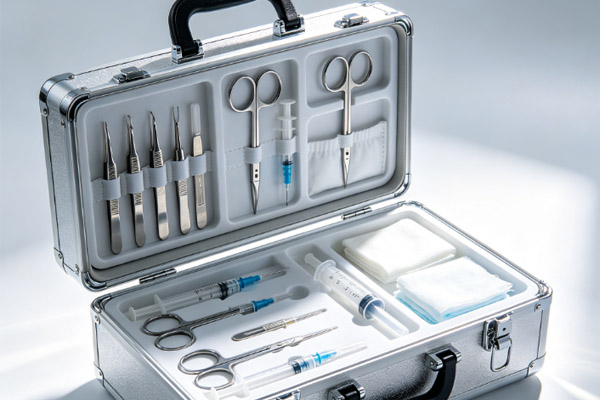
The Growing Importance of the Professional Medical House Call Toolbox
As mobile medical scenarios continue to increase, the medical house call toolbox is no longer just a simple equipment storage container but an important component of medical efficiency. A reasonable configuration helps healthcare providers maintain professionalism and stability in different scenarios.
Improves on-site treatment efficiency and reduces chaos during house calls
During house calls, many procedures need to be completed quickly. If equipment is disorganized, it not only affects on-site efficiency but also increases work pressure on healthcare providers.
- Quick access to frequently used instruments:High-frequency devices such as stethoscopes, blood pressure monitors, and thermometers should be placed in the outermost area to reduce repeated searching.
- Separate categories for medications and instruments:Basic medications and examination tools need to be stored separately to avoid cross-contamination and improve operational clarity.
- Separate management for emergency supplies:First aid supplies should have a dedicated area for faster handling during emergencies.
A well-designed zoning structure helps healthcare providers maintain a steadier work pace and improves on-site professionalism.
Enhances the professionalism of mobile medical services and optimizes patient experience
House call services focus on treatment efficiency, which also affects the patient’s overall perception of the medical service.
- More standardized tool placement:A neat and organized toolbox enhances patient trust and better meets the needs of professional medical scenarios.
- Reduces preparation time:With reasonable classification, corresponding equipment can be found quickly, reducing patient wait times.
- Improves service flow:Mobile medical scenarios change frequently; a stable storage system reduces operational chaos during visits.
Professional tool management further improves the overall house call service experience.
How to Scientifically Configure a Professional Medical House Call Toolbox
A professional house call toolbox not only needs reasonable capacity but must also align with actual medical procedures. Scientific configuration significantly improves on-site work efficiency.
Basic medical equipment configuration to meet daily house call needs
Basic examination equipment is the most core part of the entire house call toolbox, directly affecting daily examination and care efficiency.
- Basic diagnostic devices:It is recommended to include an electronic blood pressure monitor, thermometer, and pulse oximeter for routine vital sign checks.
- Routine care supplies:Gauze, alcohol cottoids, medical gloves, and similar items should be kept in stock to improve on-site care efficiency.
- Basic medication area:Can store common disinfection supplies and basic emergency medications for handling simple unexpected situations.
- Documentation area:Medical records, notebooks, and labeling tools should be managed separately to improve on-site information organization efficiency.
Once the basic equipment configuration is complete, it can meet most daily house call needs.
Functional zoning design improves tool management efficiency
Reasonable zoning and clear classification are important foundations for improving house call efficiency. Scientific layout of different equipment types reduces operational confusion and further improves on-site work efficiency.
| Configuration Zone | Main Function | Suitable Equipment |
| Diagnostic Area | Routine examination | Blood pressure monitor, pulse oximeter |
| Care Area | Wound treatment | Gauze, disinfection supplies |
| Medication Area | Drug management | Routine medications |
| Documentation Area | Information recording | Medical records and documentation tools |
- Prioritize high-frequency equipment placement:Commonly used tools should be placed in the most accessible locations to reduce operation time.
- Clearer layered structure:Different layers corresponding to different purposes help improve on-site organization efficiency.
- More intuitive label management:Use color-coded or text labels for classification, making it easy to locate items quickly.
After scientific zoning, the entire medical tool management system becomes more efficient and orderly.
Different Medical Scenarios Suit Different House Call Configuration Solutions
Different types of medical services have different requirements for a house call toolbox. Adjusting the configuration based on the actual scenario further improves overall practicality and house call efficiency.
Home care scenarios emphasize comprehensive care capability
Home care scenarios typically need to balance examination, care, and basic communication.
- Increase care supplies configuration:Wound care supplies and basic diagnostic equipment need to be more comprehensive for handling daily care issues.
- Configure portable diagnostic devices:Lightweight equipment is more suitable for frequent mobile use, reducing the burden of house calls.
- Maintain neat structure:Home environments have limited space; orderly tool placement improves the on-site operational experience.
A comprehensive configuration is more suitable for long-term home care service scenarios.
Community round visit scenarios emphasize mobility efficiency
Community rounds typically require frequent movement, so portability is a key focus.
- Control overall weight:Prioritize retaining core equipment and high-frequency supplies to reduce the strain of prolonged movement.
- Improve quick access capability:Commonly used diagnostic tools should have a designated quick-access area to improve round visit efficiency.
- Enhance durability:Frequent movement can cause wear; pressure-resistant, waterproof materials improve long-term stability.
After optimization for round visit scenarios, overall work efficiency becomes more stable.
Modern Medical House Call Toolboxes Focus More on Modularity and Specialization
As the mobile medical industry continues to develop, house call toolboxes are upgrading towards greater specialization and systemization. More and more healthcare providers are beginning to value efficient storage and the mobile diagnostic experience.
Modular design adapts to more medical needs
A modular structure allows for flexible adjustments based on different house call requirements.
- Supports quick detachment:Core equipment areas can be carried separately, suitable for short, rapid house calls.
- Easier future expansion:When adding new equipment, the layout can be flexibly adjusted, improving long-term usability.
- Stronger multi-scenario adaptability:Can adapt to different scenarios such as home care and community rounds, improving overall flexibility.
Modular design is gradually becoming an important trend in modern medical tool management.
Protection and durability performance upgrades ensure long-term stable use
Mobile medical environments are complex, so the stability of the toolbox itself is increasingly important.
- Waterproof and dustproof structure:Reduces the impact of the external environment on equipment, improving the safety of medical supplies.
- Pressure-resistant materials are more durable:Less likely to be damaged during frequent transport, suitable for long-term, high-frequency use.
- Portable mobility design:Some toolboxes include shoulder straps or wheeled structures for easy movement during long hours of house calls.
A more stable structural design helps healthcare providers improve long-term work efficiency.
A scientifically designed professional medical house call toolbox not only improves mobile medical efficiency but also helps healthcare providers establish a more standardized and stable workflow. Every detail affects the actual house call experience, from basic diagnostic equipment to care supply configuration, and from functional zoning to modular design. As the demand for mobile medical services continues to grow, professional and systematic medical storage solutions are gaining increasing attention. SIPHIA BOX focuses on professional medical storage solutions, providing more reliable support for modern mobile medical services through reasonable structural design and efficient storage concepts.