
Household essential medicines have become an important safeguard in daily life. From cold medicines and fever reducers to wound care supplies, as well as chronic disease medications and commonly used children’s medicines, the variety is becoming increasingly rich. However, issues such as disorganized placement, unclear categorization, and difficulty in managing expiration dates often cause inconvenience in daily use. Establishing a scientific household medication classification and storage solution not only improves access efficiency but also reduces misplacement and misuse, allowing family members to quickly find the needed items in daily care or emergency situations. By combining the medication needs of different family members, building a standardized, orderly, and easy-to-manage storage system has become an essential part of modern household health management.
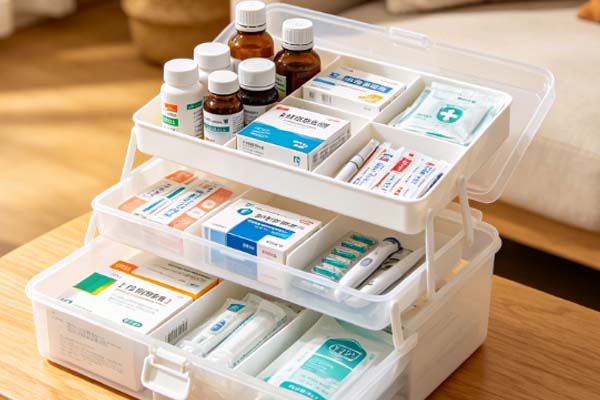
Establish a Scientific Medication Classification System
Scientific classification makes household medication management clearer and facilitates later organization and replenishment.
Classification by Medication Purpose
Classifying by purpose helps quickly locate required medicines. Cold and fever medications (such as fever reducers, cold medicines, and cough suppressants) should be stored together for daily use; gastrointestinal medicines (such as stomach medicine, antidiarrheal drugs, and probiotics) should be stored separately to maintain clear categorization; wound care supplies (such as band-aids, iodine, gauze, and medical tape) should be managed uniformly to improve emergency response efficiency. Through this classification method, medication storage becomes more organized and orderly.
Classification by User
Separating medications by household members makes daily access more convenient.
- Children’s medications: Children’s fever reducers and care supplies should be placed in a dedicated area for quick access by parents.
- Adult regular medications: Frequently used daily medicines should be stored together to improve convenience.
- Elderly long-term medications: Long-term prescriptions should be stored separately for regular management and replenishment.
Classification by user effectively reduces management issues caused by mixing.
Optimize Household Medication Storage Structure
A well-designed storage structure improves space utilization and supports long-term maintenance.
Layered and Zoned Storage
Different zones serve different storage functions, making the overall layout more intuitive.
- Frequently used medicines placed in outer layers: Commonly used medicines should be placed in easily accessible areas to improve efficiency.
- Backup medicines centrally managed: Reserve medicines should be stored together for regular inventory checks.
- Small items stored separately: Thermometers, cotton swabs, and alcohol pads should be placed in separate containers to reduce clutter.
Layered design helps improve overall management efficiency.
Modular Storage Method
Modular design meets the evolving storage needs of households.
- Independent category modules: Different types of medicines are placed into corresponding modules to maintain cleanliness.
- Flexible layout adjustment: The structure can be adjusted based on changes in medication quantity to improve space utilization.
- Easy expansion: When adding new medicines, only new modules need to be added without reorganizing the entire system.
Modular storage makes management more flexible, efficient, and easy to expand.
Household Medication Classification Reference Table
To make classification more intuitive and clear, the following is a common household medication classification reference table:
| Category Type | Main Medicines/Supplies | Storage Suggestion | Usage Frequency |
| Cold & Fever | Fever reducers, cold medicines, cough suppressants | Outer easy-access area | High |
| Gastrointestinal | Stomach medicine, antidiarrheal drugs, probiotics | Independent module storage | Medium |
| Wound Care | Band-aids, iodine, gauze, medical tape | First-aid zone | Medium |
| Children’s Medicines | Children’s fever reducers, children’s cold medicines | Independent zone | High |
| Elderly Chronic Medicines | Antihypertensive, hypoglycemic drugs, etc. | Dedicated fixed box | High |
| Daily Care Supplies | Thermometer, cotton swabs, alcohol pads | Small-item storage box | Medium |
Through scientific classification and zoned storage, household medication management efficiency and medication safety can be significantly improved.
Improve Household Medication Management Efficiency
Establishing standardized management practices helps keep medicines clean, organized, and safe over time.
Daily Medication Management
Standardized management reduces omissions and waste.
- Regular expiration checks: Timely remove expired or near-expiry medicines to ensure safety.
- Fixed storage positions: Keep medicines in consistent locations to improve retrieval efficiency.
- Timely replenishment: Restock commonly used medicines after use to meet household needs.
Standardized management helps maintain medicines in good condition.
Improve Emergency Response Efficiency
First-aid supplies should be centrally stored for quick access. At the same time, classification labels (text or color coding) should be used to improve recognition speed, and storage boxes should be placed in easily accessible locations for all family members. Proper planning ensures a more efficient and organized emergency response process.
Meet the Storage Needs of Different Households
Different household structures require different medication storage solutions.
Multi-member Households
When there are more family members, the variety of medicines is usually greater.
- Increased classification zones: Separate management for adult, children, and elderly medicines.
- Larger storage capacity: Multi-layer structures accommodate more medicines.
- Unified management habits: Fixed placement rules help all family members maintain order.
Proper planning improves overall management efficiency.
Households with Elderly and Children
Elderly and children often require more frequent medication use, making organized storage especially important.
- Prioritize frequently used medicines: Place high-frequency medicines in easily accessible areas.
- Improve recognition efficiency: Add clear labels for quick identification.
- Strengthen safety management: Keep medicines uniformly stored and organized to improve household health management.
Optimizing layout based on household characteristics enhances user experience.
The household medication classification and storage solution helps families build a more standardized and efficient health management system. From medication classification and storage structure to daily maintenance, every step affects the actual user experience. By scientifically planning storage space, optimizing classification methods, and establishing consistent management habits, household medicines can remain clean and organized, making daily access more convenient and emergency handling more efficient. SIPHIA BOX provides professional household medical storage solutions, featuring flexible modular design and high-quality storage systems, helping create a safer, cleaner, and more efficient home health management space.