
Agricultural production environments rely heavily on tools, as field operations involve seeding, irrigation, fertilization, pest control, and agricultural equipment maintenance. Traditional tool storage methods are no longer sufficient for modern high-efficiency agricultural operations. The agricultural multifunctional toolbox system adopts a unified and modular design to integrate commonly used tools, testing devices, and maintenance components, allowing agricultural workers to quickly access tools and handle on-site tasks during field operations.
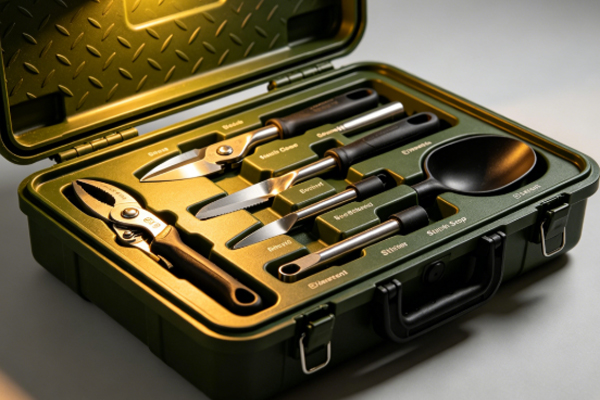
Overall Design Concept of the Agricultural Multifunctional Toolbox System
Durability and portability are emphasized in the design process. The outer shell is typically made of corrosion-resistant and impact-resistant materials, capable of withstanding complex environments such as high temperatures, humidity, and mud. The internal structure improves space utilization through partitioned storage and removable compartments, allowing tools for different purposes to be stored independently and quickly located. For agricultural scenarios involving long-term outdoor work, this structure reduces tool wear and loss while improving field management efficiency.
Core Functional Modules and Structural Composition
The agricultural multifunctional toolbox system consists of several functional modules, with each module designed for different types of agricultural operation requirements. This structure enhances both practicality and expandability.
Core functional modules include the following:
- Basic maintenance tool module: Used for equipment disassembly, screw fastening, and machinery maintenance to improve on-site repair efficiency
- Agricultural testing equipment module: Equipped with soil moisture, pH value, and temperature testing devices for farmland environmental monitoring
- Precision fertilization and spraying module: Uses measuring tools to improve fertilizer and pesticide application accuracy while reducing waste
- Power supply and lighting module: Integrates portable power supplies and lighting systems for nighttime or long-duration operations
- Quick partition storage module: Features drawer-style and compartment-style structures for rapid tool classification and access
When these modules are combined, the toolbox can meet the needs of most agricultural operation scenarios, making tool management more organized while reducing the burden of carrying multiple devices repeatedly.
Comparison of Agricultural Toolbox System Configurations
Different agricultural scales and working environments have varying requirements for toolbox system configurations. Some agricultural scenarios focus more on portability, while large agricultural bases pay greater attention to capacity and durability. Therefore, the system configuration should be planned according to actual operational requirements.
| Configuration Type | Suitable Scenario | Main Configuration Contents | Functional Features |
| Basic Toolbox | Family farms and small-scale planting | Manual tools and basic maintenance components | Lightweight structure and easy mobility |
| Standard Toolbox | Field planting and orchard management | Testing equipment, lighting systems, and repair tools | Suitable for multiple agricultural tasks |
| Reinforced Toolbox | Greenhouse agriculture and long-term outdoor work | Waterproof structure, wear-resistant components, and storage modules | Improved environmental adaptability |
| Heavy-Duty Toolbox | Agricultural machinery maintenance and large agricultural bases | Electric devices and heavy repair tools | Improved equipment maintenance efficiency |
By combining different configuration plans, agricultural operators can flexibly adjust tool structures according to actual production requirements, improve tool utilization rates, and reduce later maintenance costs.
Toolbox Materials and Durable Structural Design
Agricultural multifunctional toolboxes are often exposed to outdoor environments for long periods and must withstand humidity, dirt, high temperatures, and frequent transportation. Therefore, material selection and structural strength are critical elements of system design. High-quality toolboxes are usually made of thick engineering plastics, aluminum alloy, or rust-resistant metal materials to improve durability while maintaining a reasonable weight.
The interior commonly includes cushioning pads, anti-slip structures, and shockproof partitions to protect testing equipment and precision tools, reducing damage risks during transportation. In some agricultural scenarios, the toolbox needs to be moved frequently, so reinforced wheels and strengthened handles are added to improve transportation stability and user comfort.
To improve outdoor adaptability, many agricultural toolboxes also use sealing structures to minimize the effects of dust, moisture, and pesticide residue on internal tools. Through durable structural design, the toolbox can maintain stable performance under long-term high-intensity use and extend its overall service life.
Optimization of Field Operations and Maintenance Processes
In practical field applications, the agricultural multifunctional toolbox system improves agricultural work efficiency by optimizing tool usage and operational processes. Through standardized storage structures and modular classification design, the system reduces the time spent searching for tools and improves operational continuity on-site.
Optimization methods for field operations and maintenance processes include the following:
- Rapid preparation mode: Completes tool classification and equipment inspection before work begins, improving preparation efficiency
- Standardized operation mode: Arranges tool usage in a fixed sequence to reduce repetitive operations
- On-site emergency maintenance mode: Quickly provides maintenance tools for agricultural machinery repairs
- Flexible adjustment mode: Adjusts toolbox configurations according to different crop growth stages to improve adaptability
Through process optimization and tool integration, agricultural production sites can reduce unnecessary labor consumption, maintain a more stable operation rhythm, and improve the operational efficiency of agricultural equipment.
Application Scenarios and Implementation Value
The agricultural multifunctional toolbox system can be widely applied in field planting, greenhouse agriculture, orchard management, and agricultural machinery maintenance. In different agricultural environments, the system provides stable tool support and management capabilities, helping agricultural production become more organized and efficient.
In field planting environments, the toolbox system reduces the number of devices that need to be carried and improves mobility efficiency. In greenhouse agriculture, it supports more precise cultivation management when combined with environmental testing equipment. In orchard management, it can assist with pruning, protection, and pest control tasks. In agricultural machinery maintenance scenarios, it improves repair speed and reduces equipment downtime.
As modern agriculture continues to develop toward larger-scale operations, multifunctional toolbox systems not only improve tool management efficiency but also help agricultural operators establish more stable operational systems and improve overall agricultural productivity.