
An automotive repair toolbox is a systematic tool storage and management solution specifically designed for automotive repair, maintenance, and assembly operations. It is not merely “a box for holding tools,” but rather a professional equipment system that integrates storage, classification, protection, mobility, and efficiency improvement into one complete solution. In the modern automotive repair industry, whether in repair shops, 4S dealerships, on-site emergency repair environments, or workshop production lines, toolboxes have already become indispensable infrastructure.Universal automotive toolboxes generally include three core forms: portable toolboxes, tool carts (mobile tool cabinets), and large workshop tool cabinet systems. Different types correspond to different working scenarios. For example, portable toolboxes are suitable for mobile operations, tool carts are ideal for workshop maintenance, while large tool cabinets are designed for long-term fixed storage and heavy-duty industrial use.
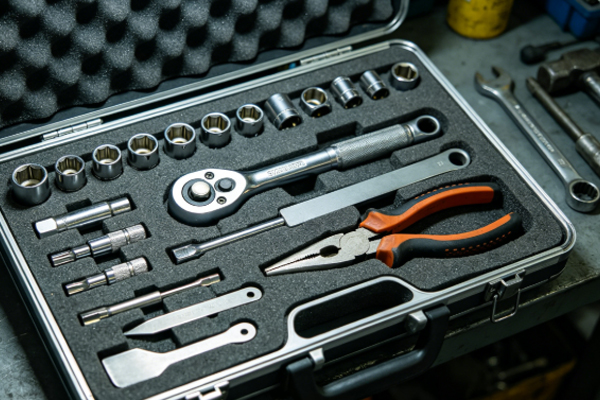
Core Value of Automotive Toolboxes
The core value of automotive toolboxes lies in improving efficiency and safety. Without proper classification, tools can easily become difficult to locate, prone to loss, and cause work delays. Through the modular design of toolboxes, tools can be managed in a clear and organized way, greatly improving repair efficiency. In addition, modern toolboxes emphasize protective performance, such as dustproofing, waterproofing, shock resistance, and corrosion resistance, making them especially suitable for construction sites or complex industrial environments. This is also why more and more companies choose professional-grade toolbox solutions rather than ordinary storage boxes.
Workflow of Automotive Toolboxes in Daily Operations
Tool Classification and Pre-Configuration Stage
Before formal use, tools should be grouped according to maintenance type, such as disassembly and assembly tools, measuring tools, electrical diagnostic tools, and specialized repair tools. After classification, they should be placed into corresponding drawers or modules to ensure quick access during operation.
Pre-Work Inspection Process
Before starting maintenance tasks, technicians should quickly inspect the toolbox condition, including whether tools are complete, whether any tools are damaged, whether drawer locks function properly, and whether the wheels move smoothly. This step helps avoid unexpected problems on site.
On-Site Usage Process
During maintenance work, the toolbox often functions as a “mobile workstation,” especially in the case of tool carts, which can be pushed directly beside the vehicle to improve efficiency. After using tools, they should be returned immediately to avoid disorder.
Storage and Reset Process
After maintenance is completed, tools must be returned according to standard procedures and checked carefully. This step is particularly important for large repair workshops because it reduces the tool loss rate.
Maintenance and Care Process
The toolbox itself also requires maintenance, such as lubricating drawer slides, rust prevention treatment, and lock inspections, in order to ensure long-term operational stability.
Core Design and Engineering Standards
High-quality toolboxes are generally manufactured using high-strength steel or engineering-grade PP composite materials, with reinforced bending structures to improve load-bearing capacity. Large tool cabinets may even adopt double-layer frame structures to withstand the long-term pressure of storing heavy tools. Common materials include cold-rolled steel plates, aluminum alloy, ABS engineering plastics, and high-density polyethylene (HDPE). Industrial-grade tool carts typically use steel bodies combined with anti-corrosion coatings to ensure they do not rust in humid or oily environments.
Modern toolboxes commonly feature sliding drawer systems and support adjustable dividers, allowing tools of different specifications to be stored separately. This design significantly improves tool management efficiency. Tool carts are usually equipped with industrial-grade universal wheels and support brake locking functions to prevent movement on slopes or construction sites. The wheels are made from wear-resistant rubber or polyurethane materials to adapt to different ground environments.They are also equipped with a central locking system, allowing one key to control all drawers, preventing tool loss or accidental opening. This feature is particularly suitable for public workshops or multi-user environments.
In industrial applications, TB Toolbox focuses on providing reliable and innovative toolbox solutions. Our products are certified according to internationally recognized standards and comply with strict quality and safety requirements, ensuring stable performance in different environments around the world.
The core advantages of TB Toolbox include:
• Providing durable, reliable, and customized tool storage solutions for global markets
• More than 500,000 toolbox deliveries accumulated worldwide
• Applications covering over 80 countries
• Completion of more than 10,000 industrial and workshop projects
Types and Applications of Automotive Toolboxes
Types of Automotive Toolboxes
Common classifications include:
• Portable automotive toolboxes (suitable for mobile repairs)
• Tool carts/mobile tool cabinets (suitable for workshops and repair shops)
• Large industrial tool cabinets (suitable for long-term fixed storage)
• Waterproof and dustproof protective cases (suitable for construction sites and outdoor use)
• Precision instrument storage cases (suitable for electronics and diagnostic equipment)
How to Use an Automotive Toolbox
The core concept is “classification + repositioning + standardized operation.” Tools should be classified before use, returned immediately during use, and checked after use in order to maximize efficiency and minimize losses.
Functions of Automotive Toolboxes
Main functions include:
• Improving maintenance efficiency
• Reducing tool loss rates
• Enhancing operational safety
• Optimizing workspace organization
• Achieving standardized management
Is an Automotive Toolbox Necessary?
For repair shops, construction site maintenance personnel, and workshop technicians, toolboxes are almost essential equipment. Without a toolbox, tools can easily become disorganized, efficiency may decline, and safety risks can increase.
Why Choose TB Toolbox?
TB Toolbox is committed to building professional-grade tool storage systems that provide high durability and customized solutions. Our products are internationally certified and suitable for various industrial environments worldwide.
Advantages Summary:
• High-strength structural design
• Multi-industry adaptability
• Proven performance in global markets
• Large-scale delivery experience (500,000+ products)
• Coverage in more than 80 countries
Frequently Asked Questions
Can toolboxes be used long-term in construction sites, high temperatures, humid environments, or oily conditions?
TB Toolbox products use industrial-grade materials and anti-corrosion coating designs that effectively extend service life.
Do different vehicle repairs require different toolbox configurations?
Through modular design, configurations can be flexibly adjusted, allowing a single toolbox to support multiple maintenance tasks.
Purchasing an automotive repair toolbox is essentially about getting “a helper that makes work easier.” Whether in repair shops, construction sites, or workshops, having a toolbox prevents tools from being scattered everywhere, makes them easier to locate, and naturally improves work efficiency. Smaller toolboxes are suitable for carrying around during repairs, larger tool carts can be pushed directly next to vehicles, while large tool cabinets are ideal for long-term workshop storage. Different working environments require different types of toolboxes in order to maximize effectiveness.
Nowadays, many professional technicians choose toolboxes because they not only store tools, but also standardize workflows and reduce mistakes and tool loss. The toolbox solutions provided by TB Toolbox are designed around the concepts of “more durable, easier to use, and more professional.” Whether you operate a repair shop, a construction team, or an industrial workshop, you can find a suitable solution.