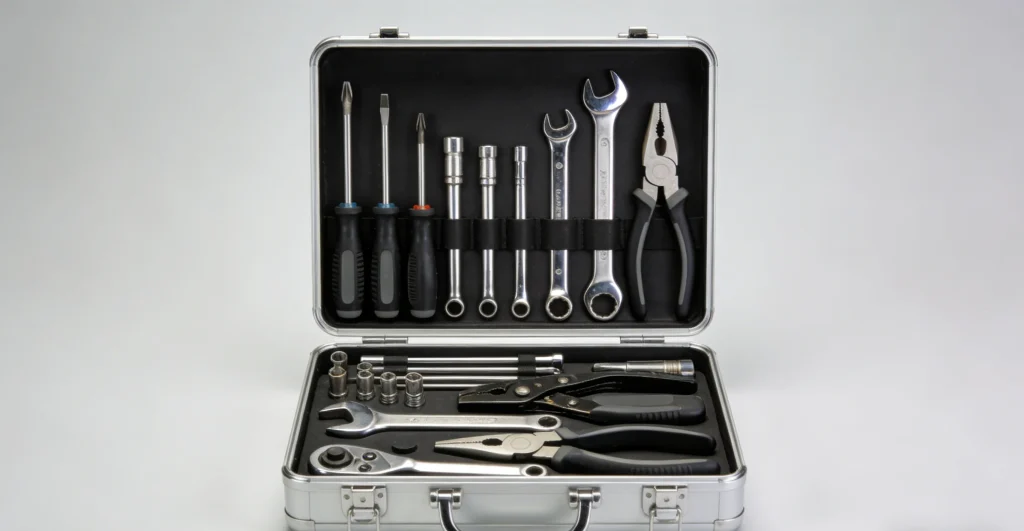
Lorry tool boxes often need to withstand greater weight in actual use than ordinary storage boxes. When wrenches, socket sets, jacks, power tools, hydraulic tools, and various spare parts are stored together inside the box, the weight continuously acts on the bottom of the box. During vehicle operation, road bumps can also cause these items to move up and down, making the actual load on the bottom greater than the weight under stationary conditions. Therefore, whether the bottom of a lorry tool box needs reinforcement cannot be determined only by the box size. It should also be evaluated based on the weight of the stored items, aluminum plate thickness, box length, installation position, and vehicle operating environment.
For small boxes used to store a limited number of lightweight tools, additional reinforcement may not be necessary if the bottom structure is properly designed. However, for large aluminum tool boxes, truck side-mounted tool boxes, and products used to carry heavy tools for long periods, bottom reinforcement is generally a more reliable option. Common methods include adding reinforcing ribs, increasing the bottom plate thickness, installing transverse supports, adding bent structural sections, or placing support plates at load-bearing positions. These structures can reduce problems such as bottom sagging, deformation, and long-term fatigue. It should be noted that reinforcement does not simply mean increasing material thickness. The bottom structure also needs to work together with the box side panels, mounting brackets, and vehicle fixing points. Otherwise, excessive local stress may occur.
When Does a Tool Box Bottom Need Reinforcement?
Reinforcement Is More Necessary When Storing Heavy Tools
The pressure placed on the bottom of a lorry tool box can vary significantly depending on the items stored inside. If the box mainly contains lightweight tools such as screwdrivers, measuring tapes, gloves, and pliers, the load on the bottom is usually relatively limited. However, if it needs to store jacks, socket sets, power tools, hydraulic tools, or large quantities of metal parts, the weight can increase quickly. When these items remain concentrated in the same area for a long time, the bottom plate is continuously subjected to pressure. Therefore, heavy-duty tool boxes require greater consideration of bottom reinforcement.
The Larger the Box, the More Reinforcement May Be Needed
The bottom plate of a large lorry tool box usually has a relatively large surface area. If the bottom has a long span and lacks support in the middle, even if the aluminum plate itself has a certain level of strength, it may gradually sag or deform after supporting heavy items for a long period. Especially for boxes with a long overall length and no internal partitions, additional bottom support should be considered according to the actual load requirements.
How Can the Bottom of a Lorry Tool Box Be Reinforced?
Reinforcing Ribs Are a Common Method
Adding reinforcing ribs to the bottom of the box can improve the overall rigidity of the bottom plate. The ribs can be arranged along the length or width of the box so that when the bottom plate is subjected to pressure from heavy items, the load can be distributed over a larger area. This method does not necessarily require a significant increase in aluminum plate thickness, allowing structural stability to be improved while controlling overall weight. The positions of the reinforcing ribs should also not be selected randomly. They should be designed according to the tool box dimensions, mounting brackets, and main load-bearing areas.
Increasing the Bottom Plate Thickness Improves Load Capacity
For tool boxes with higher load-bearing requirements, a thicker aluminum plate can also be used for the bottom. Increasing the bottom plate thickness generally improves bending resistance, but it also increases the box weight and material cost. Therefore, if the box is only intended to store a small number of tools, there is no need to blindly use an excessively thick bottom plate. A more reasonable approach is to select the plate specification according to the actual load and then use reinforcing ribs and other structural features for additional support.
Bottom reinforcement methods for lorry tool boxes:
Add reinforcing ribs: Reduce the bottom plate span and improve overall rigidity.
Appropriately increase plate thickness: Suitable for tool boxes with higher load-bearing requirements.
Add transverse supports: Help distribute concentrated loads and reduce local deformation.
Optimize mounting support points: Allow loads acting on the bottom of the tool box to be transferred to the vehicle fixing structure.
Bottom Reinforcement Also Needs to Consider Vehicle Operation
Static Weight Does Not Equal Actual Load
When a lorry is parked and stationary, the tool box only needs to support the weight of the items stored inside. However, the situation changes once the vehicle starts moving. When passing over speed bumps, uneven roads, or construction roads, the tool box is subjected to continuous vibration and impact. If heavy metal tools are stored inside, these tools may generate relatively large instantaneous forces as they move during bumps.
Mounting Brackets Also Affect Bottom Load Distribution
After reinforcing the tool box bottom, the mounting brackets also need to be checked. If the bottom is very strong but the number of mounting brackets is insufficient or their positions are unreasonable, the load during vehicle operation may still be concentrated at only a few points. Under these circumstances, local deformation of the box may occur. Therefore, the bottom reinforcement structure, mounting brackets, and vehicle fixing points should be designed together. For large tool boxes, manufacturers can adjust the bracket spacing and load-bearing positions according to the vehicle installation locations, allowing the tool box to be fixed more securely to the vehicle body.
Frequently Asked Questions
Q1: Do All Lorry Tool Boxes Need Bottom Reinforcement?
A1: Not necessarily. If a lightweight tool box only stores a small number of tools and its existing structure already meets the load-bearing requirements, additional reinforcement may not be necessary. However, large tool boxes or heavy-duty tool boxes generally require greater consideration of bottom reinforcement.
Q2: Is a Thicker Bottom Plate Always Better?
A2: No. A thicker bottom plate increases both weight and cost. A reasonable design should select the plate thickness according to tool weight, box dimensions, and vehicle operating conditions, and then improve load-bearing capacity through reinforcing ribs and support structures.
Q3: Can a Deformed Aluminum Tool Box Bottom Be Repaired?
A3: Minor deformation can be corrected according to the box structure. However, if the bottom plate has obvious cracks, damaged welds, or structural instability, further inspection is required. If necessary, the bottom plate should be replaced or the structure should be reinforced again.
Q4: Does a Truck Tool Box Need Reinforcement If a Jack Is Stored Inside?
A4: If the jack is relatively heavy and remains concentrated on the bottom of the box for a long period, it is recommended to consider the bottom load-bearing design in advance. Reinforcing ribs, a thicker bottom plate, or a dedicated load-bearing area can be used to reduce local pressure.
Whether the bottom of a lorry tool box needs reinforcement mainly depends on the box dimensions, tool weight, frequency of use, and vehicle operating environment. However, for large aluminum tool boxes, truck side-mounted tool boxes, and products intended to store heavy maintenance equipment, the bottom structure should be given particular consideration. Reinforcement methods can include adding reinforcing ribs, appropriately increasing the bottom plate thickness, installing transverse supports, and optimizing mounting support points. Reinforcing ribs can reduce deformation across a large bottom plate area, an appropriately thicker plate can improve bottom load-bearing capacity, and properly positioned mounting brackets can transfer the weight acting on the tool box to the vehicle structure.
It is particularly important to note that a lorry tool box is not an ordinary storage box used in a stationary environment. Vibration and impact occur while the vehicle is traveling, and uneven roads, speed bumps, and construction roads can cause heavy items inside the box to generate additional forces. Therefore, when designing the load-bearing structure, actual vehicle operating conditions should be taken into consideration. If the tool box is used for long-term storage of heavy items such as jacks, hydraulic tools, or large socket sets, it is recommended to clearly specify the bottom load-bearing requirements during the purchasing stage. The manufacturer can design reinforcement structures according to the box dimensions, aluminum plate thickness, and installation position to prevent bottom sagging or deformation from being discovered only after the product has been put into use.