
In the daily operations of enterprises, the level of safety assurance systems directly affects overall management performance. First aid supplies, as essential emergency resources, play a critical role in various scenarios such as offices, production sites, warehouses, and public service environments. However, in actual use, many companies still face issues such as scattered storage, unclear categorization, untimely inventory updates, and low retrieval efficiency, which can negatively impact emergency response speed. By building a systematic enterprise first aid supplies storage solution, companies can effectively improve space utilization, promote standardized management, and ensure that all emergency materials remain clearly organized, orderly, and easily accessible, thereby enhancing overall safety management capabilities.
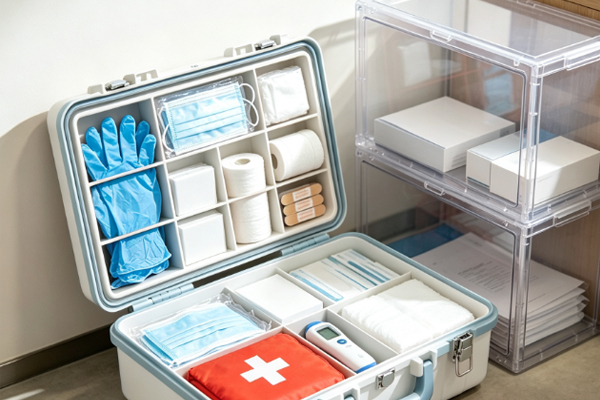
Establish a Standardized Classification System for First Aid Supplies
A scientific classification method is the core foundation for improving the efficiency of first aid supply management. By properly dividing storage areas, daily management processes can be significantly optimized.
Classification by Usage Purpose
Separating first aid supplies based on their functions helps improve retrieval and usage efficiency.
- Trauma care supplies: Band-aids, gauze, bandages, medical tape, etc., are stored together for handling common injuries.
- Disinfection and cleaning supplies: Alcohol pads, iodine solution, disinfectant wipes, etc., are categorized separately to ensure hygiene and safety.
- Protective supplies: Disposable gloves, masks, protective face shields, etc., are managed uniformly for quick access.
Through functional classification, the overall storage structure becomes more intuitive and easier to maintain and replenish.
Placement Based on Usage Frequency
Planning storage space according to usage frequency helps improve operational efficiency.
- High-frequency items placed in front: Commonly used supplies are stored in easily accessible areas to reduce retrieval time.
- Backup materials centralized: Inventory consumables are stored together for regular stocktaking.
- Specialized items stored separately: Special medical supplies are placed in dedicated areas for better identification.
- This approach significantly improves the overall management efficiency of enterprise first aid supplies.
First Aid Supplies Classification and Storage Reference Table
| Category Type | Main Items | Recommended Storage Location | Management Focus |
| Trauma Care Supplies | Band-aids, gauze, bandages, tape | Middle layer / High-frequency area | Fast access, timely replenishment |
| Disinfection Supplies | Alcohol pads, iodine, disinfectant wipes | Independent sealed area | Anti-contamination, anti-evaporation |
| Protective Supplies | Gloves, masks, face shields | Outer layer / Convenient area | Easy access and replenishment |
| Backup Consumables | Spare gauze, stock medicines | Lower layer / Storage area | Regular inventory checks |
| Specialized Medical Supplies | Special emergency equipment | Independent modular area | Managed by assigned personnel |
Optimize the Storage Structure of First Aid Supplies
A well-designed structure improves space utilization while making the management of different categories more efficient and organized.
Layered Storage Design
A layered layout enables more structured material management.
- Upper layer for frequently used items: Band-aids, disinfectants, etc., are placed in visible and accessible positions for quick use.
- Middle layer for care supplies: Bandages, gauze, cotton swabs, etc., are stored in an organized manner.
- Lower layer for backup inventory: Spare consumables are centrally managed for unified replenishment and allocation.
Through layered design, the entire storage system becomes more stable and efficient.
Modular Combination Management
Modular design allows flexible adjustment of storage structures based on different enterprise scenarios. Independent units are used to categorize and store first aid supplies, making the overall layout clearer. It can also be flexibly configured according to office areas, production zones, or warehouse environments, improving adaptability. When new emergency supplies are added, expansion modules can be used to maintain system consistency and scalability. This approach significantly enhances management flexibility and space utilization efficiency.
Improve the Enterprise First Aid Supplies Management System
A standardized management mechanism is the foundation for ensuring the long-term effective use of first aid supplies.
Daily Inspection Management
Regular maintenance ensures that supplies remain in usable condition.
- Regular inventory checks: Timely replenishment of consumed items to avoid shortages.
- Expiration date management: Regular removal of near-expiry products to ensure safety.
- Fixed placement maintenance: Unified storage standards improve employee familiarity.
Through institutionalized management, risks of omission and waste can be effectively reduced.
Improve Emergency Response Efficiency
A well-established management system significantly enhances the ability to handle emergencies.
- Fast material location: Clear classification reduces search time.
- Simplified management process: Standardized operations facilitate cross-department collaboration.
- Strengthened safety assurance: Ensures first aid supplies remain in optimal condition.
This provides more stable safety support for enterprise operations.
Applicable to Multiple Enterprise Scenarios
Different types of enterprises have varying requirements for first aid supply storage, so flexible configuration is necessary to improve adaptability.
Office Environments
Office environments prioritize cleanliness and convenience. First aid supplies are typically placed in meeting rooms, reception areas, and other accessible locations for quick employee use. Compact storage solutions are used to save space, while centralized management improves maintenance efficiency, enhancing overall workplace safety and standardization.
Factory and Warehouse Environments
Production and warehouse environments require broader coverage and faster emergency response.
- Multi-point deployment: Independent storage stations are set up in different areas to improve emergency efficiency.
- High-frequency replenishment system: Ensures consumables are replenished in a timely manner.
- Durable structural design: Adapts to complex environments and long-term use requirements.
Proper configuration significantly enhances overall enterprise safety assurance capabilities.
The completeness of an enterprise first aid storage system directly affects daily management efficiency and emergency response capability. Through scientific classification, layered structure, modular design, and standardized management processes, enterprises can build a more efficient, organized, and safe emergency material management system. SIPHIA BOX focuses on professional storage system development,