
Home care services take place in different locations, requiring caregivers to carry medical devices, care supplies, sterile consumables, and auxiliary items of different sizes. Storage cases need to provide sufficient capacity while also managing the spatial relationship between clean supplies, used items, and specially stored products. A well-designed portable storage solution allows caregivers to quickly identify item locations within limited space while reducing collisions, compression, and mixing during transportation, making mobile care work more organized.
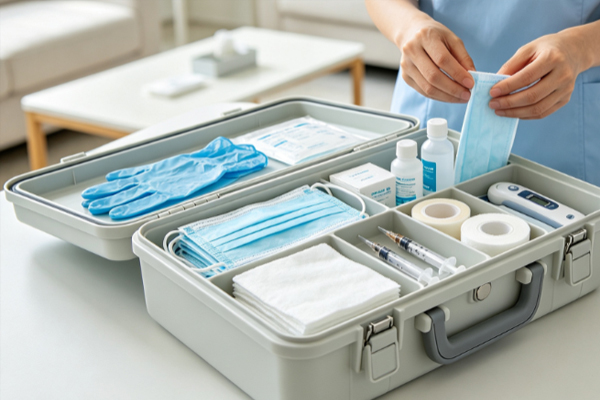
How Should Medical Supplies for Home Care Be Organized by Zones?
Medical supplies should not be arranged solely according to size. Different areas should also be established based on usage status, cleanliness, and care procedures, allowing caregivers to quickly identify and access the required items.
Sterile Supplies and Regular Supplies Should Be Stored Separately
Sterile dressings and other disposable sterile supplies have relatively strict requirements for package integrity and storage conditions, so a relatively independent area can be created for these items.
- Separate Storage: Keep sterile supplies separate from regular care supplies to reduce mutual compression and mixing.
- Package Protection: Create fixed spaces according to supply dimensions to prevent package damage during transportation.
- Clear Identification: Use labels, compartments, or transparent storage bags to quickly identify different supply categories.
A well-defined clean storage area makes it easier for caregivers to manage unused supplies while maintaining an orderly storage system.
Used Items Should Be Handled Separately
Wound care, blood collection, and other procedures may generate contaminated dressings, disposable items, and sharps. Medical waste should be collected in dedicated packaging or containers according to its category and should not be returned to the clean area. Sharps should be placed in dedicated containers, while infectious waste should also be collected separately to prevent mixing with unused supplies. Portable storage can reserve an independent temporary storage area for contaminated items, creating a clear boundary between the clean area and waste area.
How Can Portable Storage Cases Improve Access Efficiency for Caregivers?
Caregivers move between different homes, communities, and service locations, where available working space is often limited. The internal layout should make frequently used supplies easy to find while keeping different devices securely positioned.
Plan the Internal Space According to the Care Workflow
Storage areas can be arranged around actual care procedures so that caregivers can quickly identify item locations after opening the case.
| Storage Area | Suitable Contents | Design Focus |
| Sterile Supplies Area | Sterile dressings, disposable supplies | Separate storage, avoid compression |
| Frequently Used Supplies Area | Gauze, cotton swabs, tape, etc. | Quick access |
| Medical Device Area | Blood pressure monitors, thermometers, etc. | Fixed positioning, impact protection |
| Emergency Module Area | Emergency supplies configured according to care tasks | Clear identification, quick recognition |
| Temporary Contaminated Item Area | Relevant used waste | Separate collection, reduced mixing |
Clear spatial division can reduce searching and make it easier for caregivers to complete preparation before use and organization after use.
Emergency Supplies Should Be Kept in a Highly Visible Position
Emergency supplies may be needed unexpectedly and should not be buried among large quantities of regular consumables. Clear labels, transparent mesh bags, independent modules, or fixed storage positions can help caregivers identify them quickly after opening the case. For team use, the location and labeling method of the emergency module can also be standardized so that different personnel develop similar retrieval habits when using the same storage system.
How Should Temperature Control and Transport Protection Be Provided for Special Medical Supplies?
Some medicines, reagents, and specimens have specific requirements for temperature, light exposure, and transportation time. The storage structure should provide independent spaces for these items instead of mixing them with regular care supplies.
Temperature-Sensitive Supplies Need Independent Storage Space
Some medicines and reagents need to be stored and transported according to specified temperature requirements. Portable storage solutions can be equipped with insulation or temperature-control modules according to actual needs, with dedicated space for temperature monitoring.
- Independent Temperature Control: Keep items requiring specific temperature conditions separate from regular consumables.
- Reduce Temperature Fluctuations: Select suitable insulation structures according to transportation time and external environmental conditions.
- Record Temperature: For items subject to temperature management requirements, temperature recording devices can be configured according to the actual management process.
- Avoid Direct Contact with Cooling Sources: When ice packs or coolants are used, appropriate separation methods should be arranged according to the requirements of the specific item.
The storage structure should serve the actual storage conditions rather than applying the same temperature-control method to all medicines and reagents.
Specimens and Testing Supplies Need Leak and Impact Protection
Collected blood and other specimens should be transported according to the requirements of the specific testing procedure. Independent containers, sealed structures, and fixed inner linings can reduce the risk of movement and leakage during transportation. For testing equipment, customized EVA inserts or positioning slots can also be designed according to the instrument dimensions, with the main unit, probes, cables, and accessories arranged in separate spaces to keep the equipment stable inside the case.
How Can Home Care Teams Establish a Standardized Portable Storage Solution?
As the number of caregivers increases, allowing each person to organize supplies according to personal habits can easily lead to inconsistent storage positions, missed replenishment, and difficulties with inventory checks. Standardized modules can make storage methods more consistent and facilitate future adjustments.
Establish Different Modules According to Care Tasks
Teams can create basic care, testing, emergency, sterile supply, and special-item modules according to actual work requirements, then combine them based on the day’s tasks.
- Basic Care Module: Centralize frequently used daily supplies.
- Testing Module: Create fixed spaces according to equipment dimensions.
- Emergency Module: Use clear identification and maintain quick access.
- Sterile Supplies Module: Provide a relatively independent clean storage area.
- Special Items Module: Configure corresponding structures for temperature, light protection, and other requirements.
Modular configurations allow caregivers to adjust what they carry according to their work tasks while reducing the amount of low-frequency equipment occupying space over the long term.
Establish Fixed Locations and Daily Inventory Checks
Keep similar supplies in fixed locations, return them according to unified procedures after use, and regularly check quantities, package condition, and expiration dates.
- Sterile supplies should be checked for package integrity.
- Special-storage items should be checked according to their applicable storage requirements.
- Used medical waste should be collected and transferred according to the classification and handover procedures established by the organization.
A fixed storage system can reduce differences caused by staff changes while also making it easier for teams to replenish supplies and manage inventory.
The key to portable storage equipment for home care is enabling caregivers to efficiently carry, access, and organize supplies according to actual work requirements. Functional zoning can create an orderly storage system and allow one portable case to support a wider range of mobile care tasks. SIPHIA BOX can provide toolbox storage solutions based on medical supply specifications, equipment dimensions, care workflows, and carrying methods, creating storage configurations tailored to home care, mobile healthcare, and on-site service applications.