
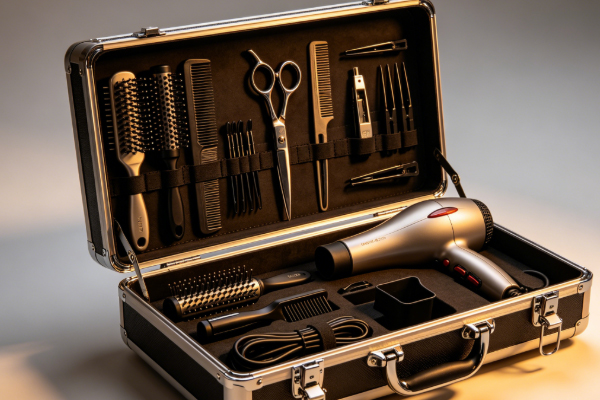
A hair styling tool box is used to centrally store and manage various styling tools, improving operational efficiency and convenience. A well-designed internal structure and functional layout help keep tools organized, reduce searching time, streamline styling workflows, and minimize wear and damage during transport or daily use.
Tool Configuration and Usage Logic
A hair styling tool box plays an important role in organizing tools and optimizing workflow in salon services and daily styling operations. Different working environments require different internal layouts and functional configurations. Hair cutting, coloring, and detailed styling processes all require efficient access to tools, making capacity planning and access routes essential in design.
High-frequency tools are usually placed in the most accessible positions, such as scissors, clippers, and commonly used combs. Chemical products and care items are better stored in layered compartments to reduce interference during operation. With a well-structured internal layout, switching between tools becomes faster, improving workflow continuity and service stability.
Core Structure of the Tool Box
The structural design of a hair styling tool box directly determines usage efficiency and tool protection performance. A well-planned internal layout significantly improves workflow smoothness.
In most designs, tools are categorized into functional zones for easier identification and access.
- Cutting Tool Zone: for scissors, thinning shears, and trimming tools, focusing on secure fixation and anti-slip design
- Electrical Equipment Zone: for clippers, curling irons, and similar devices, requiring heat resistance and shock protection
- Consumables Zone: for hair dye, styling sprays, and care products, enabling quick replenishment
- Auxiliary Tool Zone: for combs, clips, and small tools, emphasizing fast access and clear categorization
These functional divisions reduce tool clutter, improve organization efficiency, and lower the risk of damage caused by movement or collision during transport.
Material and Durability Design
Hair styling tool boxes require materials that balance lightweight structure and high-strength protection. Different material combinations determine durability and applicable environments.
Common designs use ABS engineering plastic as the outer shell, combined with aluminum alloy frames to enhance structural support. Internal shock-absorbing materials reduce tool vibration and wear during transport. ABS material provides strong impact resistance and is suitable for frequent mobility, while aluminum structures improve stability while controlling weight.
Internal padding often uses EVA or foam materials to protect electrical devices. Some designs also include waterproof coatings to adapt to humid or frequently cleaned environments, extending overall service life.
Functional Module Comparison and Applications
Different types of hair styling tool boxes vary significantly in functional design. Each module structure corresponds to different usage scenarios and operational needs.
| Functional Type | Main Features | Application Scenario | Advantages |
| Basic Storage Type | Simple structure, limited compartments | Personal use or entry-level styling | Low cost, lightweight |
| Professional Layered Type | Multi-drawer modular design | Salon professionals | Clear classification, high efficiency |
| Electrical Integrated Type | Built-in power and heat insulation | High-end styling environments | Supports multiple devices simultaneously |
| Portable Mobile Type | Lightweight with wheels | Mobile and outdoor services | Flexible movement, high space efficiency |
These different structures correspond to different working intensities and tool dependencies. Choosing the right type reduces repetitive organization and improves operational efficiency.
Storage and Portability Optimization
Optimization of storage and mobility focuses on space utilization and operational convenience. Modular designs allow flexible adjustment of internal layouts, keeping frequently used tools in easy-to-reach positions while storing less-used tools deeper inside.
Elastic fixing straps secure long tools and electrical devices, preventing movement during transport. Some designs include transparent panels for quick internal visibility.
For portability, tool boxes often include reinforced handles and silent wheel systems for smooth movement. Lightweight structures reduce carrying fatigue while maintaining durability, making cross-environment usage more flexible.
Usage Scenarios and Maintenance Strategy
Hair styling tool boxes serve different roles depending on the working environment. In fixed salon settings, emphasis is placed on organized storage and stability, while mobile styling services require stronger portability and shock resistance.
Daily maintenance includes the following:
- Regular cleaning of internal compartments to prevent residue buildup from dyes or chemical products
- Lubrication of metal hinges and locks to ensure smooth operation
- Keeping electrical storage areas dry to avoid circuit aging or damage
- Returning tools to designated positions to maintain structural order
Proper maintenance extends the service life of the tool box and ensures long-term efficiency in tool management.