Musical instruments require reliable protective equipment during daily carrying, practice, and transportation. Different protection methods directly affect the instrument’s lifespan and safety. Soft cases and instrument cases are the two most common choices, but they differ significantly in structural design, protective capabilities, and suitable environments. Some users prefer lightweight and portable soft cases, while others trust sturdy and durable instrument cases. Choosing a case that doesn’t match the intended use can easily increase the risk of damage during handling or storage. Therefore, understanding the differences between the two is crucial.
Fundamental Differences Due to Structural Materials
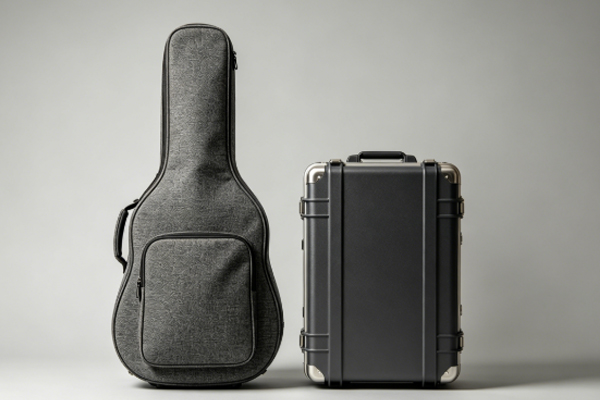
Soft cases are typically made of flexible materials such as nylon, Oxford cloth, or polyester, with a thin foam padding layer inside. They are lightweight and can be shaped to fit the instrument, offering greater flexibility in storage. They can be folded for space-saving storage, making them suitable for everyday portability.
Instrument cases, on the other hand, are constructed from rigid materials such as ABS plastic, wood, or carbon fiber composites. The overall structure is fixed and cannot be deformed. The interior usually uses molded foam or custom molds to precisely conform to the instrument’s contours, keeping the instrument stable inside.
- oft-sided cases are lightweight and flexible, allowing for easy storage.
- Instrument cases have a fixed structure and stronger pressure resistance.
- Soft-sided cases are foldable, while instrument cases are not compressible.
These structural differences determine their different protective logics.
Comparison of Impact Resistance and Protection
Instrument cases are significantly more impact-resistant. Their hard-shell structure disperses impact force, reducing direct damage to the instrument. They are suitable for transport, long-distance shipping, or handling in complex environments. Even in the event of a drop or crush, they provide a higher level of safety protection.
Soft-sided instrument cases rely on internal foam for cushioning, absorbing minor impacts. However, their protection is limited when facing larger impacts or heavy pressure. They are more susceptible to external forces in crowded, frequent, or transported environments.
- Instrument cases are suitable for high-intensity transport environments.
- Soft-sided cases are suitable for short-distance and low-risk carrying.
- Hard-shell structures offer more stable pressure resistance.
These differences in protection directly determine their applicability.
Differences in Weight and Portability
Soft-sided instrument cases offer a significant advantage in portability. They are lighter overall, reducing the burden of carrying them, making them suitable for daily practice, short commutes, or walking. Some soft-sided cases also feature a carrying system, allowing them to be used like a backpack, improving comfort during movement.
Hard-sided instrument cases, due to their rigid structure, are relatively heavier, especially wooden or reinforced models. This increases the burden during extended carrying, but in return, they offer greater safety and structural stability, making them more suitable for fixed storage or professional transportation.
- Soft-sided cases are suitable for frequent movement
- Hard-sided instrument cases are more suitable for fixed transportation
- Soft-sided cases offer better carrying comfort.
A trade-off between portability and protection needs to be made based on the frequency of use.
Internal Fixation and Instrument Stability
The internal structure of instrument cases typically uses a molded design, with the space closely matching the shape of the instrument. When closed, it firmly secures the instrument, reducing internal movement and thus lowering the risk of collisions caused by displacement during transportation. This structure significantly improves stability. While instrument pouches offer some cushioning, their stability is relatively weak. Instruments may still have slight movement within the pouch, making them prone to friction or minor damage during long-term transport or frequent movement.
- Instrument cases offer more precise and stable fixing structures.
- Pouches rely on padding, resulting in weaker stability.
- High-end pouches can enhance support.
Stability directly impacts long-term protection.
Applicable Scenarios and Selection Recommendations
Pouches are more suitable for daily practice, indoor storage, and short-distance transport. They provide sufficient convenience in stable environments with low transport risks, reducing carrying burden and making them ideal for frequent users.
Instrument cases are better suited for performance transport, long-distance travel, and shipping scenarios. They offer stronger protection in complex environments, effectively reducing the impact of external forces on instruments and better meeting safety requirements.
- Pouches are suitable for daily practice and short-distance transport.
- Instrument cases are suitable for performance and shipping environments.
- Different environments require different protection methods.
Choosing appropriate protective equipment can keep instruments more stable in different scenarios.