In modern industrial manufacturing, automotive repair, equipment maintenance, and construction projects, tool management efficiency has become a key factor affecting work quality. As the number of tools continues to grow, traditional toolboxes are no longer sufficient to meet professional needs for storage, organization, and mobility. Tool chests have gradually become essential equipment for many businesses and technicians thanks to their large storage capacity, multi-level organization, and convenient mobility. However, there are many types of tool chests available on the market, and different structures and configurations are designed for different applications.
Drawer Tool Chests
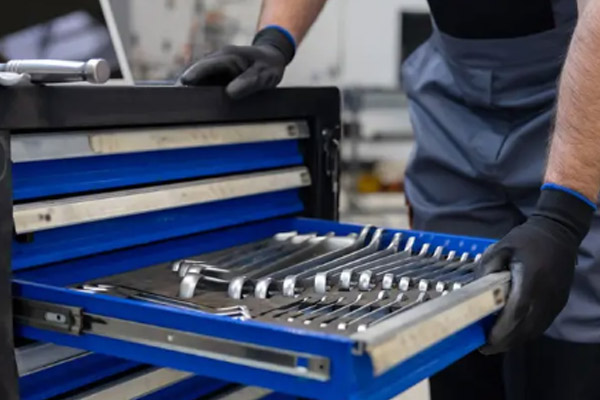
Drawer tool chests are currently the most widely used type, especially in work environments where tools need to be accessed frequently.
Multi-Drawer Design
The multi-layer structure helps users establish a clear and organized tool management system.
- Better Organization: Different drawers can store different types of tools, such as wrenches, screwdrivers, and measuring instruments.
- Higher Retrieval Efficiency: Fixed storage locations reduce searching time and improve productivity.
- Improved Space Utilization: Vertical storage design maximizes the use of internal space.
A well-designed drawer layout makes tool management more organized and efficient.
Ideal for Professional Maintenance Applications
Drawer-style tool chests are widely used in automotive repair and equipment maintenance industries.
- Convenient Access to Frequently Used Tools: Common tools can be stored in upper drawers for quick retrieval.
- Supports Large Tool Collections: Suitable for professional environments with a wide variety of tools.
- Improves Workflow Efficiency: Reduces time spent searching for tools and streamlines maintenance processes.
For high-frequency work environments, drawer tool chests offer significant advantages.
Rolling Tool Chests
Rolling tool chests combine storage and mobility, making them ideal for multi-station work environments.
Enhanced Mobility
Many workplaces require tools to be moved frequently, making mobility a critical feature.
- Tool chests can be easily moved around workshops, warehouses, or construction sites.
- High-quality caster wheels reduce pushing resistance while improving stability and maneuverability.
- Tools can be relocated quickly as work positions change, helping improve on-site productivity.
Excellent mobility can significantly enhance overall work efficiency.
Adaptable to Complex Work Environments
Different work scenarios have different requirements for tool transportation.
- Suitable for Large Workshops: Facilitates cross-area operations and improves tool allocation efficiency.
- Suitable for Construction Sites: Reduces tool transportation time and accelerates project progress.
- Suitable for Equipment Maintenance: Improves response speed and ensures maintenance continuity.
Rolling tool chests are becoming an increasingly important choice in the modern maintenance industry.
Stackable Tool Chests
Stackable designs have become one of the most popular tool management solutions in recent years.
More Flexible Modular Configuration
Different modules can be freely combined according to specific needs.
- Expand Based on Tool Quantity:
Additional modules can be added as tool collections grow without replacing the entire system.
- Flexible Layout Adjustments:
Allows customization for different work environments and tasks.
- Improved Space Utilization:
Provides greater storage capacity within limited space.
Flexible expandability is one of the key advantages of stackable tool chests.
Easier Transportation and Portability
The modular structure improves transportation convenience.
- Removable Individual Modules:
Users can carry only the tools required for a specific task.
- Reduced Carrying Weight:
Makes transportation easier and more efficient.
- Ideal for Field Work:
Meets the needs of on-site maintenance and repair tasks.
This design is especially practical for professionals who frequently work in different locations.
Heavy-Duty Industrial Tool Chests
Heavy-duty tool chests are primarily designed for industrial production and large-scale maintenance environments.
Greater Load Capacity
Industrial environments often require storage for a large number of heavy tools.
- Reinforced Steel Construction Improves Overall Strength and Stability.
- Heavy-Duty Storage Design Supports Large Tools and Equipment.
- Reliable Long-Term Performance with Reduced Risk of Deformation or Damage.
Their high load-bearing capacity makes them particularly suitable for professional applications.
Designed for High-Intensity Work
Demanding environments require superior durability.
- These tool chests are capable of supporting long-term, high-intensity industrial operations.
- They offer excellent impact resistance and can withstand challenging working conditions.
- Their extended service life helps reduce maintenance and replacement costs.
A durable and stable structure ensures long-term productivity.
Open-Style Tool Chests
Open-style tool chests focus on maximizing accessibility and efficiency.
Quick Tool Access
The open design eliminates the need to repeatedly open and close drawers, allowing tools to remain visible and easily accessible. Users can quickly locate the tools they need, reducing search and waiting times while improving workflow efficiency. In assembly lines or environments where tools are used frequently, this design enables immediate access to tools, enhancing productivity and operational continuity. Open-style tool chests prioritize convenience and speed, making them ideal for fast-paced work environments.
Suitable for Light Maintenance Tasks
For applications involving a relatively small number of tools, open-style tool chests offer excellent practicality. Their simple and intuitive structure supports routine maintenance and basic repair tasks, allowing users to access tools quickly without complicated operations. These tool chests are also generally more cost-effective, helping small and medium-sized businesses manage tools efficiently while controlling procurement costs. In light-duty work environments, open-style tool chests are a popular choice due to their convenience and practicality.
There is no single standard type of tool chest, as different designs are intended for different applications. From the efficient organization of drawer tool chests and the mobility of rolling tool chests to the modular expansion of stackable tool chests and the high load capacity of heavy-duty industrial models, each type offers unique advantages for specific work environments. When selecting a tool chest, businesses and individuals should consider factors such as the number of tools, frequency of use, and working conditions to choose the most suitable solution.