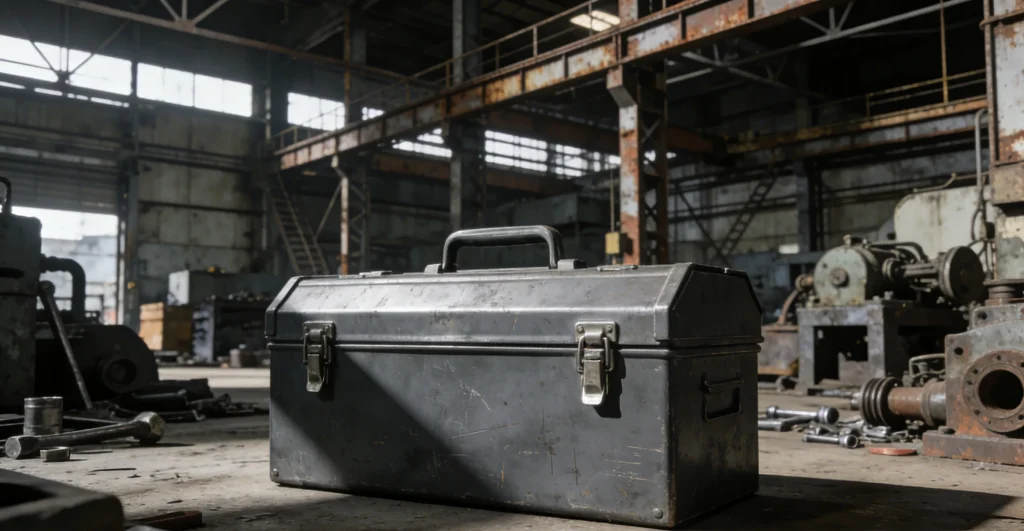
Stackable toolboxes often need to withstand the weight of tools, repeated handling, impacts to the box, and the pressure caused by stacking multiple units. For automotive repair, engineering construction, industrial maintenance, and outdoor work, toolbox durability directly affects tool protection and long-term usage costs. Assessing the durability of a stackable toolbox should not be based solely on the thickness of the outer shell or its appearance and finish. It should also involve a comprehensive evaluation of the box material, structural strength, stacking and locking system, hardware, and water and dust resistance.
Assessing Stackable Toolbox Durability Through the Box Material
The box material determines the toolbox’s basic impact resistance, deformation resistance, and long-term performance, making it one of the key factors in assessing durability.
Impact-Modified PP Is More Suitable for Heavy-Duty Tool Storage
Engineering-grade stackable toolboxes generally place greater emphasis on impact resistance and weight balance.
- Modified PP is suitable for frequent handling: Impact-modified polypropylene offers good toughness and is suitable for repeated handling at construction sites, repair workshops, and in outdoor environments.
- Material toughness should be considered in low-temperature environments: When a toolbox is used during winter or in low-temperature conditions, the material’s impact resistance can affect the risk of cracking.
- ABS is suitable for specific product structures: ABS offers good rigidity and dimensional stability, but it should not simply be regarded as the universal mainstream material for high-strength outdoor stackable toolboxes. When making a purchase, its specific formulation, structure, and manufacturing process should be considered.
Actual durability is also closely related to the material formulation, box thickness, and structural design.
Box Structure Affects Long-Term Load-Bearing Performance
Material strength can only be fully utilized through proper structural design. Reinforcing ribs can reduce deformation of large box panels under heavy loads or impact. The bottom structure needs to provide stable support to withstand the continuous pressure from toolboxes stacked above it. The corners of the box should also be reinforced to reduce damage caused by impacts during handling.
Stacking Connections and Hardware Determine Usage Stability
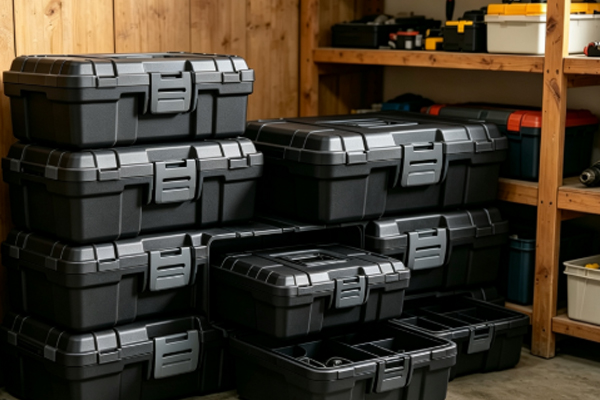
The core advantage of stackable toolboxes is that multiple boxes can be combined for use. The stability of the stacking structure directly affects tool transportation and the long-term user experience.
The Stacking and Locking Structure Needs to Be Stable and Reliable
During movement and transportation, multiple stacked toolboxes rely on reliable positioning and locking structures to maintain a stable connection. Precise alignment can reduce box movement, durable latches can withstand repeated assembly and disassembly, and designs compatible with modules of different sizes and functions make it easier to expand storage capacity as the number of tools increases.
Hinges, Handles, and Latches Also Require Attention
A sturdy toolbox body does not necessarily mean that all components offer the same level of durability.
- Hinges affect the service life under frequent opening and closing: When a toolbox is opened repeatedly every day, the hinges continuously withstand tension and torsion and therefore need to provide strong connections.
- Latches affect the stability of box closure: Reliable latches can reduce the risk of the lid opening accidentally during transportation.
- Handles need to match the tool weight: Once a toolbox is filled with metal tools, its weight increases significantly. The connection between the handle and the box must therefore have sufficient strength.
When selecting a toolbox, pay close attention to how the hardware is connected to the box. These details often reveal more about long-term performance than the exterior design.
Water and Dust Resistance and Impact Resistance Determine Adaptability to Complex Environments
When a toolbox is used for extended periods in construction, repair, or outdoor environments, durability means more than structural strength. It also includes protection against dust, moisture, and external impact.
Assessing Sealing Performance Through the IP Rating
The water and dust resistance of a toolbox should not be judged solely by marketing claims. Check the IP rating and test conditions specified by the manufacturer. At the same time, inspect whether the box opening is equipped with a continuous sealing gasket and whether the latches work effectively with the sealing structure. Ratings such as IP65 can serve as a reference, but the actual usage environment must also be taken into account.
Impact Resistance Affects Long-Term Service Life
During actual use, toolboxes inevitably experience impacts, drops, and frequent handling.
- The box is less likely to crack after impact: Materials with good toughness and reinforced structures can reduce damage caused by severe impacts.
- The structure remains stable during stacked transportation: After multiple toolboxes are combined, the overall weight increases, and the connection points need to withstand continuous pressure and transportation impacts.
- Internal tools need to be protected: Proper dividers, foam padding, or securing structures can reduce tool movement and collisions inside the box.
Combining impact resistance with internal protection structures can further improve the reliability of the entire tool storage system.
Assessing Long-Term Durability Based on the Usage Scenario
The intensity of use for the same stackable toolbox can vary significantly between a home DIY environment and an industrial construction site. A product suitable for long-term use needs to match the actual tool weight, handling frequency, and working environment.
Professional Repair and Construction Scenarios Place Greater Emphasis on Structural Strength
Automotive repair, industrial maintenance, and engineering construction typically involve heavy tools and frequent handling.
- Heavy tools require stable support: When wrenches, sockets, power tools, and other equipment are stored together, attention should be paid to the load-bearing capacity of the box bottom, stacking structure, and handle.
- Frequent assembly and disassembly require reliable hardware: When the toolbox is opened repeatedly and modules are frequently removed and reassembled, the hinges, latches, and connection mechanisms need to offer good durability.
- Multi-level transportation requires a stable combination: Stacked toolboxes should maintain a secure connection to reduce movement or separation during transportation.
Professional users should prioritize stackable toolboxes with high structural strength, stable connections, and the ability to withstand long-term, high-frequency use.
Home and DIY Scenarios Place Greater Emphasis on Overall User Experience
Home users generally do not require extreme load-bearing capacity, but they still need good long-term performance.
- Lightweight materials make movement easier: A box with a reasonable weight can reduce the effort required for daily handling.
- Clear organization reduces tool collisions: A well-designed internal structure allows different tools to be stored separately.
- Modular design facilitates future expansion: As the number of tools increases, additional modules can be added, avoiding the need to frequently replace the entire storage system.
When choosing a product, home users can prioritize box weight, internal layout, expandability, and ease of operation.
When selecting a stackable toolbox, the tool weight, handling frequency, and working environment should also be evaluated in practical terms. For professional repair, engineering construction, and long-term tool management, stable modular connections, reliable hardware, and clearly defined protection specifications can help a toolbox meet more demanding usage requirements. SIPHIA BOX focuses on professional tool storage solutions and can provide stackable and modular toolbox designs based on tool types, usage environments, and storage needs, helping users improve tool organization efficiency and space utilization.