
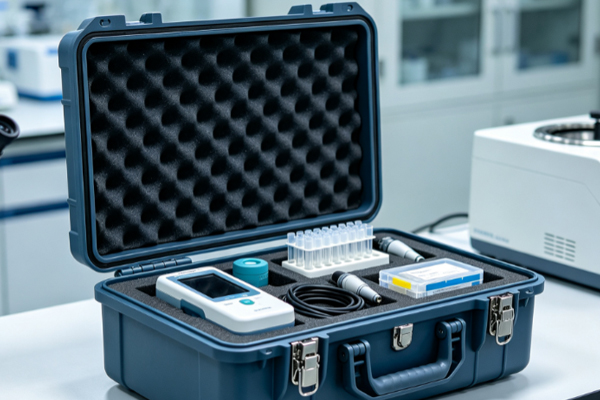
Medical research work often involves laboratory transfers, on-site testing, sample collection, and equipment maintenance. A single instrument may also be equipped with probes, sensors, cables, reagents, and auxiliary components. During transportation, equipment may be affected by vibration, impact, moisture, and static electricity, while ordinary cases often have difficulty providing appropriate protection for different components. Dedicated storage cases for medical research equipment can be designed around equipment fixation, environmental protection, temperature and humidity management, and organized access, creating a more complete solution for the transportation and storage of precision instruments.
What Protection Problems Do Dedicated Storage Cases for Medical Research Equipment Need to Address?
The protection requirements of medical research instruments are not limited to preventing physical impact. Different devices may also have specific requirements for static electricity, humidity, light, and ambient temperature. Storage solutions need to identify protection priorities according to the type of equipment.
Precision Electronic and Optical Equipment Requires Multi-Layer Protection
Testing instruments, optical equipment, electronic modules, and sensors may contain components that are sensitive to mechanical impact and static electricity. During transportation, displacement, friction, and external interference need to be minimized.
- EVA foam inserts, positioning slots, or fixed supports can be designed according to the equipment shape.
- For static-sensitive electronic equipment, anti-static or static-dissipative liner materials can be used according to actual requirements.
- Optical components need protection against impact, scratches, and prolonged exposure to humid environments.
- Main units, probes, cables, and other accessories can be stored in separate areas to reduce mutual friction.
For ESD-sensitive components, protective packaging should be selected according to actual static-control requirements rather than using ordinary foam uniformly for all equipment.
Different Equipment Requires Matching Internal Structures
Medical research equipment varies considerably in size, weight, and precision level, so internal spaces can be configured according to specific equipment types.
| Equipment Type | Recommended Storage Structure | Main Protection Focus |
| Precision testing instruments | Custom EVA inserts, positioning slots | Shock resistance, fixation |
| Optical equipment | Separate compartments, cushioning inserts | Impact protection, moisture protection |
| Electronic analysis equipment | Anti-static liners, fixed structures | ESD, vibration |
| Sampling equipment | Divided compartments, dedicated container spaces | Organization, leak prevention |
| Probes and sensors | Small positioning slots, soft liners | Impact protection, quick access |
Configuring structures according to equipment characteristics can reduce internal gaps and make it easier for researchers to quickly identify instruments and accessories.
How Can Medical Research Equipment Transportation Balance Shock, Moisture, and ESD Protection?
When equipment is transferred between laboratories, research institutions, and on-site testing locations, external impact and environmental changes may affect instrument conditions. Case design needs to combine external protection with internal positioning.
The Case Exterior Needs to Provide Stable Environmental Protection
During transportation, equipment may encounter dust, moisture, impact, and temperature or humidity fluctuations. The case can be configured according to the environmental conditions specified by the equipment manufacturer.
- Select a case with appropriate impact resistance according to the transportation method.
- For outdoor or complex environments, sealing, dustproof, and waterproof structures can be configured.
- For optical equipment stored for extended periods, desiccants or humidity indicator cards can be added according to environmental conditions.
- For equipment sensitive to temperature and humidity, case protection should not simply be understood as complete sealing. Heat dissipation and equipment operating requirements also need to be considered.
The actual storage environment should comply with the corresponding instrument’s operating and storage requirements, while the case mainly provides supplementary protection during transportation and storage.
Internal Structures Need to Combine ESD and Mechanical Protection
Precision electronic equipment may face static electricity risks in dry environments and during frequent handling. Ordinary foam does not inherently provide ESD protection. For static-sensitive equipment, anti-static or static-dissipative EVA, conductive or dissipative materials can be configured as needed, together with grounding and an overall ESD control strategy. Positioning slots, cushioning layers, and separation structures can also reduce equipment movement and provide targeted protection for different sensitive components.
How Should Separate Storage Areas Be Designed for Samples and Reagents?
During medical research, instruments may need to be transported together with reagents, samples, and sampling tools. Different items have different requirements for temperature, sealing, cleanliness, and safety, so they should not all be placed in the same space.
Reagents and Temperature-Sensitive Materials Need Dedicated Temperature-Controlled Spaces
Some reagents, enzyme preparations, and research samples have specific transportation temperature requirements. Storage cases can be designed with independent temperature-controlled compartments or insulated areas according to the actual conditions.
- Select insulated or refrigerated structures according to the temperature range specified for the product.
- Reserve space for temperature-recording devices to facilitate condition monitoring during transportation.
- Provide appropriate separation between cooling media and materials to prevent direct contact from causing localized temperature abnormalities.
- Reserve sufficient temperature-retention capacity according to the transportation duration.
Different samples and reagents have different storage requirements. A single cold-chain solution cannot be applied to all research materials. Sample transportation should also be designed according to transportation time, temperature range, and testing requirements.
Samples and Potentially Contaminated Materials Need Separate Sealed Protection
Biological samples cannot rely on ordinary internal compartments as a substitute for required transportation packaging. According to the relevant risks and transportation requirements, they should use primary containers, sealed leakproof secondary containers, and external packaging, together with absorbent and cushioning measures. Liquid samples should have leakproof trays or dedicated secondary-container spaces. Potentially infectious materials or other regulated substances should also be packaged and labeled according to applicable transportation requirements to reduce the risks of leakage, contact between materials, and mixing with precision instruments.
How Can Dedicated Storage Cases for Medical Research Equipment Achieve Integrated Customization?
Equipment and accessories used in medical research projects are often highly specialized, while standard storage spaces can result in excessive gaps, mixed accessories, or a lack of dedicated areas for special items.
Design Modular Internal Spaces According to Equipment Combinations
Before customization, equipment dimensions, weights, accessory quantities, and usage sequences can be organized before determining the specific storage structure.
- Main Unit Module: Configure dedicated positioning areas according to the instrument shape.
- Accessory Module: Provide dedicated spaces for probes, cables, power supplies, and sensors.
- ESD Protection Module: Configure appropriate liners for static-sensitive electronic components.
- Temperature-Control Module: Provide independent spaces for reagents or materials requiring specific temperature conditions.
- Protection Module: Add cushioning structures for optical components, fragile parts, and precision components.
A modular layout can establish clear boundaries between instruments, accessories, and special materials while also making future adjustments easier.
Adjust Case Configurations According to Laboratory and Field Research Scenarios
Internal laboratory transfers mainly focus on equipment fixation, organization, and access efficiency, while external testing requires greater impact resistance, portability, and environmental protection. For long-term research projects, expansion space can also be reserved so that additional probes, sensors, or accessories can be incorporated into the existing storage system.
Medical research equipment storage solutions should be built around actual workflows rather than simply increasing case capacity. For electronic-sensitive instruments, optical components, and reagents or samples with different characteristics, dedicated ESD-protective liners, reinforced shock- and moisture-resistant positioning structures, as well as independent temperature-control, sealed-container, and compartmentalized designs can be configured. SIPHIA BOX can provide tool cases, protective cases, aluminum cases, and customized storage solutions according to equipment dimensions, weight, internal components, and transportation environments, offering detailed structural configurations for laboratory equipment transfers, on-site testing, research project transportation, and precision instrument storage.