
Planting and livestock industries rely on a wide range of tools in daily operations, including field cultivation equipment, livestock management tools, and machinery maintenance instruments. Due to the diversity of tools, high usage frequency, and complex working environments, traditional scattered storage methods often lead to tool damage, loss, and low retrieval efficiency. The integrated storage and protection solution for full-category tools in planting and livestock maintenance provides a unified and systematic storage approach, enabling centralized management and classified placement of different tools. This improves operational order and reduces environmental impact during handling, transportation, and storage.
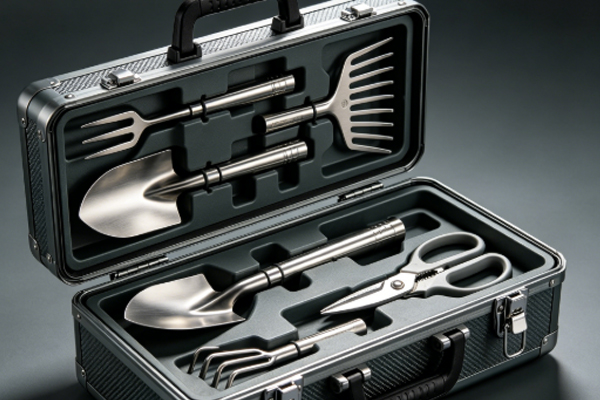
Classification of Full-Category Tools and Modular Structure
The solution adopts a modular design to categorize tools based on operational functions and application scenarios, ensuring quick access and efficient management across planting, livestock, and maintenance tasks.
Tool classification and modular structure include:
- Planting operation tool module: Used for pruning, fertilizing, seeding, and spraying tasks in agricultural production
- Livestock management tool module: Used for feeding management, cleaning, disinfection, and environmental maintenance
- Agricultural machinery maintenance module: Used for equipment disassembly, repair, and fault handling
- Inspection and measurement tool module: Used for temperature, humidity, soil, and water quality testing to improve operational accuracy
- Protective storage module: Uses shock-absorbing partitions and sealed structures to protect precision tools and reduce transport damage
Through structured classification and modular combination, tools can be quickly accessed and accurately returned, improving field efficiency while reducing costs caused by misplacement or repeated procurement.
Tool Storage Protection Structure and Material Design
The planting and livestock environment is characterized by high humidity, dust exposure, and frequent transportation, making durability and protection key design priorities. The system typically uses engineering plastics, reinforced aluminum alloys, or anti-rust metal materials to ensure structural strength while maintaining manageable weight for mobility.
The internal structure is designed with shockproof layers, cushioning pads, and compartment reinforcements to reduce damage caused by vibration and impact during transportation. This is especially important for precision instruments and maintenance tools that require long-term stable storage. Some systems are equipped with reinforced locks, upgraded handles, and wheel assemblies to improve portability and operational safety.
Sealing structures are also widely applied to prevent moisture, dust, and corrosive substances from entering the storage space, effectively extending tool lifespan and reducing maintenance costs.
Tool Configuration Levels and Selection Reference
Different scales of planting and livestock operations require different storage capacities and protection levels. Selecting appropriate configurations helps improve operational efficiency and reduce unnecessary costs.
| Configuration Level | Suitable Scenario | Structural Features | Functional Focus |
| Basic Configuration | Family farms and small livestock sites | Lightweight structure, basic compartments | Daily tool storage and portability |
| Standard Configuration | Medium-scale farms and livestock operations | Multi-module compartments | Covers planting, livestock, and basic maintenance |
| Reinforced Configuration | Large farms and long-term outdoor operations | Enhanced protection, thickened structure | Improved durability and environmental resistance |
| Professional Configuration | Agricultural maintenance centers and integrated bases | Large-capacity modular system | Supports complex maintenance and multi-tool management |
By selecting different configuration levels, operators can flexibly match storage systems to operational scale, improving resource utilization and adapting to real working environments.
Tool Management Process and Field Efficiency Optimization
The solution not only focuses on storage structure but also optimizes field tool management processes to improve operational efficiency. Standardized classification, partitioned storage, and structured management reduce tool searching time and improve response speed in field operations.
Optimization methods include:
- Rapid preparation mode: Completes tool inspection and classification before operations begin to improve efficiency
- Zonal management mode: Separates planting, livestock, and maintenance areas to reduce confusion
- Emergency maintenance support mode: Quickly deploys maintenance tools to reduce equipment downtime
- Regular maintenance mode: Standardized cleaning and inspection to extend tool lifespan
Through structured management, operational workflows become smoother, tool loss is reduced, and unnecessary procurement costs are minimized.
Application Scenarios and Long-Term Value
The integrated storage and protection solution is widely applicable in field planting, greenhouse agriculture, aquaculture, livestock farming, and agricultural machinery maintenance. Across different environments, it provides stable tool storage and protection capabilities, ensuring organized and efficient operations.
In planting environments, it reduces the number of tools carried and improves field mobility. In livestock environments, classified storage reduces cross-contamination risks. In maintenance scenarios, it improves tool retrieval speed and reduces equipment downtime. For large-scale farms and integrated agricultural bases, the system helps establish standardized tool management practices, improving long-term operational stability and resource efficiency.