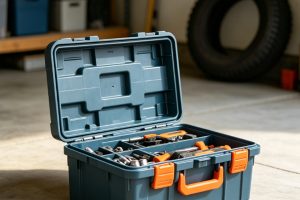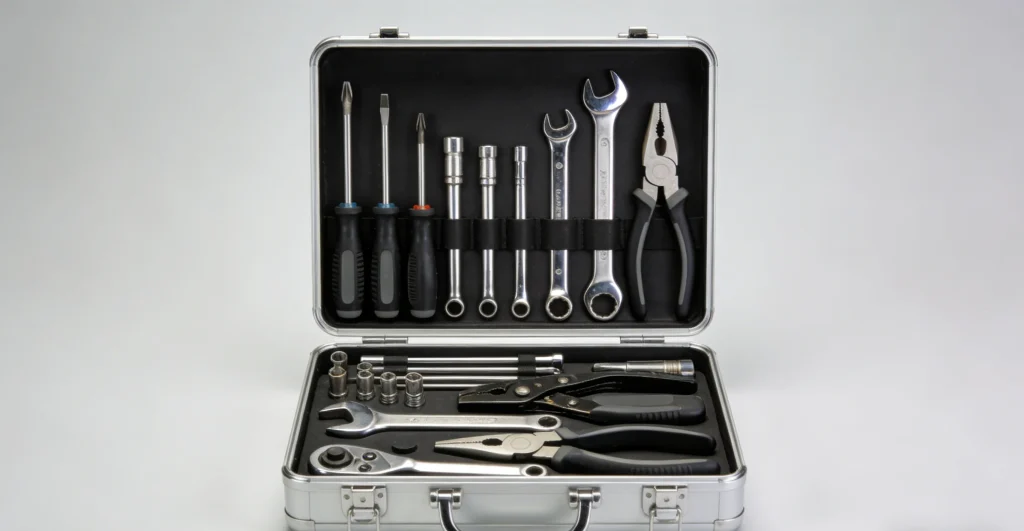
In engineering maintenance sites, time is often more important than the tools themselves. Once equipment fails, maintenance personnel must not only identify the problem quickly, but also bring the required tools to the site in the shortest possible time. Traditional fixed storage methods can hold tools, but they are difficult to meet the needs of fast movement, categorized organization, and on-site response at the same time. A rolling tool box integrates storage, transportation, and access into one system, allowing tools to move in sync with maintenance tasks. It is especially suitable for workshops, factories, machine rooms, and other engineering environments that require frequent back-and-forth movement, which is why more and more maintenance teams are adopting it as part of their daily equipment.
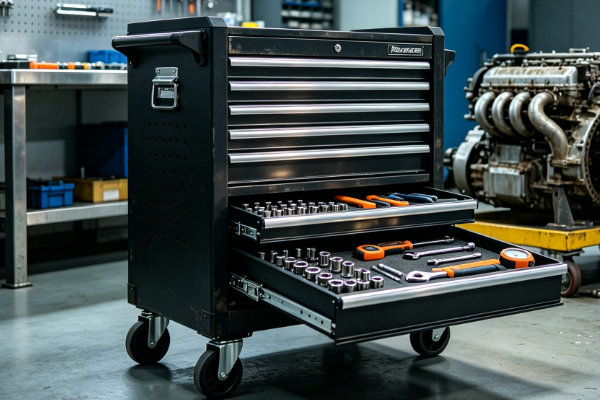
Rolling Tool Boxes Make Maintenance Movement More Efficient
Engineering maintenance is not always completed at a fixed workstation. In many cases, workers need to move quickly between different areas. The core value of a rolling tool box is to make tool movement easier and more direct.
Easier On-Site Transfer
A rolling tool box uses wheels to turn tools that would otherwise need to be carried by hand into equipment that can be pushed directly.
- The wheeled design reduces the burden of lifting and carrying, especially for maintenance tasks involving many tools or heavy equipment.
- When dealing with large machines or multi-point inspections, tools can be pushed to the site in one trip, reducing repeated back-and-forth movement.
- For maintenance personnel who move frequently, the time saved can be used more quickly for fault handling.
This mobility not only saves effort, but also makes the entire maintenance process more continuous.
Tools Are Ready to Use at Any Time
A rolling tool box keeps commonly used tools in one system, allowing maintenance personnel to start work immediately upon arrival. Wrenches, screwdrivers, measuring tools, and other frequently used items can be stored together to avoid scattered placement; during maintenance, there is no need to repeatedly return to the warehouse for parts, reducing time wasted on unnecessary trips; in emergency repair or urgent maintenance scenarios, having tools within easy reach can significantly improve response speed. Tools being ready at any time means higher maintenance efficiency and a more stable on-site workflow.
Rolling Tool Boxes Make Tool Management Clearer
Engineering maintenance tools come in many types and specifications. Without proper classification, it is easy to lose track of them, pick the wrong one, or store them in a disorganized way. Through layered and zoned design, a rolling tool box makes tool management more intuitive and easier to standardize.
More Clear Categorized Storage
Rolling tool boxes are usually divided according to usage frequency and tool type, making it easier for maintenance personnel to organize them quickly.
- The upper layer is suitable for frequently used tools, while the lower layer can store spare parts and consumables.
- Small parts, bits, connectors, screws, and similar items can be stored in separate compartments to reduce the risk of loss.
- Tools required for different trades can also be separated by module to avoid confusion caused by mixed storage.
A clear categorization method turns tool management from “finding it” into “grabbing it quickly.”
More Convenient Access Logic
A well-designed internal layout not only makes storage easier, but also helps maintenance personnel work more smoothly.
- Once tool positions are fixed, users can more easily develop stable habits for taking and returning items.
- During on-site operations, there is no need to rummage through the entire box, reducing ineffective actions and repeated organizing.
- After use, tools can be returned quickly, keeping the tool box in a ready-to-use condition at all times.
A smooth access logic makes maintenance work more fluid and better suited to high-frequency operations.
Rolling Tool Boxes Are Better Suited to Complex Engineering Scenarios
Engineering maintenance environments are usually space-limited, task-changing, and often accompanied by dust, oil, and vibration. In such complex environments, a rolling tool box demonstrates greater practical value than a standard tool box.
Adaptable to Multiple Work Environments
The flexibility of a rolling tool box allows it to fit different types of engineering maintenance sites. Whether in factory workshops, equipment rooms, storage areas, temporary repair points, or cross-site work locations, it can be moved quickly with its wheel structure, helping maintenance personnel bring tools directly to where they are needed; when facing different maintenance tasks, the tool configuration can also be adjusted according to actual needs, keeping commonly used tools and specialized accessories properly matched; for teams that require collaboration and frequent location changes, one rolling tool box system can cover more work points, reducing the trouble caused by repeated carrying and scattered management.
Better for Team Collaboration
In multi-person maintenance environments, a unified tool management method is especially important.
- When shared by multiple users, tool locations are consistent and handovers are clearer.
- Maintenance teams can prepare different modules according to tasks to improve collaboration efficiency.
- Inventory checks, replenishment, and tool inspections are also more convenient, reducing management confusion.
A solid collaboration foundation helps the entire maintenance team execute more efficiently.
Rolling Tool Boxes Offer Longer-Term Value
When many companies choose tool storage equipment, they do not only consider whether it is sufficient for today, but also whether it can continue to expand in the future. Rolling tool boxes perform better in durability and scalability, making them more suitable for long-term use.
Stronger Expansion Capability
As maintenance tasks increase, the number of tools often grows as well.
- Additional storage modules can be added according to actual needs, making expansion more flexible.
- There is no need to replace the entire set of equipment at once, which helps reduce later investment costs.
- From individual maintenance to team management, upgrades can be completed gradually through modular expansion.
This scalability makes rolling tool boxes more suitable as a long-term tool management solution.
More Conducive to Standardized Management
A unified tool box system is not only convenient for storage, but also helps establish standardized workflows.
- Once tool placement is fixed, management rules are easier to implement.
- Tool wear, loss, and duplicate purchases can be significantly reduced.
- For companies, this not only improves efficiency, but also lowers operating costs.
The value brought by standardized management becomes more and more obvious over long-term use.
The reason engineering maintenance cannot do without rolling tool boxes lies in the fact that they solve four problems at once: mobility, categorization, efficiency, and management. For maintenance personnel who need to rush to the site frequently and respond to faults quickly, a rolling tool box is not just a storage container, but an important piece of equipment for improving work efficiency. SIPHIA BOX provides professional rolling tool box solutions to help engineering maintenance teams bring tools to the site, manage them better, and use them faster.