Workshop tools are increasing in number, and what really troubles managers is often not the quantity of tools, but how to accommodate more tools in limited space while keeping them easy to access. Traditional shelves or ordinary toolboxes are prone to issues such as tool stacking, aisle obstruction, and scattered parts. Box tool carts centralize tools that were originally scattered in different locations through vertical layering, drawer classification, and mobile storage, improving storage efficiency without significantly increasing floor space. For automotive repair, equipment maintenance, factory production lines, and professional workshops, a properly configured box tool cart can help make more full use of limited workshop space.
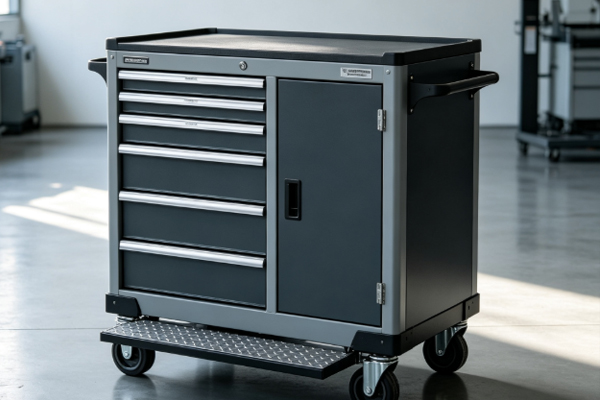
Vertical Layered Design Improves Workshop Space Utilization
Workshop space planning needs to balance storage capacity and personnel activity areas. Box tool carts use upper and lower layering to allow a single unit to handle more storage tasks.
Multi-layer Drawers Reduce Floor Space Occupation
Different tools come in different sizes, and multi-layer drawers can establish corresponding areas based on actual usage needs.
- Small tools stored together: Screwdrivers, wrenches, pliers, and similar tools are suitable for shallow drawers, reducing scattered placement on workbenches.
- Large tools reasonably zoned: Sockets, hammers, power tools, and other larger tools can be placed in deep drawers, improving vertical space utilization.
- Parts stored independently: Small items such as screws, washers, and connectors can be organized with divider boxes, reducing scattered parts.
By combining drawers of different depths, one tool cart can handle multiple storage tasks, reducing the pressure of configuring additional storage equipment.
Fixed Storage Positions Reduce Duplicate Space
Once tools have clear positions, temporary stacking in the workshop can also be improved.
- Workbenches stay tidy: Frequently used tools are centralized in the tool cart, reducing long-term occupation of the work surface.
- Less clutter around equipment: Maintenance tools no longer remain scattered beside machines for long periods, helping maintain activity space around equipment.
Once tools are fixed in place, workshop space can be planned more consistently, and daily organization becomes more convenient.
Mobile Storage Makes Workshop Space More Flexible
Fixed tool cabinets are suitable for long-term storage, while box tool carts can change position according to work tasks, allowing the same set of tools to serve multiple areas.
One Cart for Multiple Areas
For workshops with multiple repair stations, shared mobile storage can reduce duplicate configuration.
- Move with repair stations: During automotive repair and equipment maintenance, the tool cart can be moved directly to the corresponding work area.
- Multi-station tool sharing: Different stations can use the same tool cart according to work arrangements, reducing the need to duplicate tools in each area.
- Quick transfer for temporary work: During production line inspection or equipment maintenance, relevant tools can be brought together to the site and returned to the designated area after completing the work.
Mobile design extends tool management from fixed locations to actual work positions, making space arrangements more flexible.
Reduce Clutter Around Aisles and Workbenches
Tools left on the floor, beside equipment, or near workbenches for long periods easily form temporary stacking areas. Box tool carts can concentrate scattered tools into one mobile unit, reducing the occupation of aisles and work areas by tools. After reasonably planning the parking position of the tool cart, workshop traffic flow can also become clearer.
Categorized Storage Frees Up Workbenches and Storage Areas
Space utilization is also closely related to how tools are placed. Through classification, layering, and management by frequency of use, space waste between different areas can be reduced.
Separate Management of High-frequency and Low-frequency Tools
Tools with different usage frequencies can be stored in different locations.
- High-frequency tools on upper layers: Screwdrivers, wrenches, pliers, and other tools used frequently in daily work can be placed on top or in upper drawers, reducing retrieval movements.
- Low-frequency tools on lower layers: Backup tools, large tools, and infrequently used accessories can be placed at the bottom or in deep spaces, freeing up prime storage positions.
Such a layout allows limited space to serve more tools while maintaining retrieval efficiency.
Divide Areas According to Workflow
Professional workshops involve many types of tools, and classification according to work content is more conducive to long-term management.
- Automotive repair classification: Tools can be organized according to engine, chassis, electrical testing, and other work content.
- Equipment maintenance classification: Mechanical tools, electrical tools, and testing equipment can be placed in different storage areas.
- Production line maintenance classification: Corresponding tool areas can be established for different equipment, making it easier for staff to quickly confirm the needed items.
After planning internal space according to workflow, tool management can better fit work habits and reduce the need to search for tools across different areas.
Proper Configuration of Box Tool Carts Is Needed to Leverage Space Advantages
The tool cart itself also needs to match workshop conditions. Size, drawer structure, load capacity, and mobility configuration jointly affect actual use.
Choose the Right Size According to Workshop Area
Workshop space conditions vary greatly, and tool cart size needs to be combined with actual aisles and workstation layout.
- Small repair areas: Compact tool carts can be chosen to reduce impact on aisles and work areas.
- Large workshops: Larger-capacity tool carts can be chosen according to the number of workstations and tool scale.
- Narrow areas: Focus should be placed on cart body width and turning space to avoid affecting other equipment during movement.
Only when size matches the workshop layout can the advantages of mobile storage be fully realized.
Pay Attention to Drawer Layout and Internal Space
Internal structure determines whether the tool cart can truly deliver storage value.
- Shallow drawers: Suitable for screwdrivers, wrenches, pliers, and small accessories.
- Deep drawers: Suitable for power tools, sockets, and larger equipment.
- Adjustable partitions: Through dividers, divider boxes, or custom liners, internal space utilization can be further improved.
Reasonably combining different storage areas can reduce idle space and make tool management more orderly.
Movement and Parking Also Need Planning
When tool carts are moved frequently, attention should be paid to caster stability, load capacity, and braking structure. Staying stable after reaching the work position can prevent the tool cart from affecting operations. The workshop can also set up fixed parking areas so that tools can be returned in time after use, keeping the overall space tidy.
When purchasing a box tool cart, in addition to size and number of drawers, comprehensive planning can also be made based on tool types, workshop layout, usage frequency, and movement distance. For enterprises that need long-term tool management, a suitable internal structure can reduce the cost of later reorganization and equipment replacement. SIPHIA BOX focuses on toolboxes, protective cases, aluminum alloy cases, and customized storage solutions. It can design internal structures around tool dimensions, equipment characteristics, and actual application needs, providing storage solutions that better fit actual usage requirements for maintenance, inspection, engineering, and other scenarios.